

Realizing improved fuel economy with consistent driving performance
Idling Stop is a system that automatically stops the engine when the vehicle is brought to a stop at signals and then activates as the car sets off again. Vehicles often keep their engines running even when stopped, but a vehicle with Idling Stop improves fuel economy by turning off the engine.
Technology Functionality
The Idling Stop is active when the engine is sufficiently warm and when the vehicle speed has gone over 20km/h. After stepping on the brake and stopping the vehicle, the Idling Stop is activated after around 1 second. While the brake pedal remains pressed down the vehicle continues to be stationary. To move off, the driver removes his or her foot from the brake pedal and in about 0.4 seconds the engine restarts. When the brake is on, the engine can also be restarted by turning the steering wheel, allowing drivers to prepare for moving off quickly when turning or pulling into traffic.
For conditions when the vehicle appears to be repeatedly performing parking maneuvers, or when repeatedly stopping and moving off at speeds of under 8km/h in congested traffic, the vehicle assesses the situation and controls the Idling Stop. In this way, the stopping and restarting of the engine will not annoy the driver.
Drivers can still use their car audio and navigation systems while the Idling Stop is in operation. The air conditioning automatically switches to ventilation, but when cooling or warming the inside of the car is a priority, the Idling Stop can then be switched off at the press of a button.
Technology Configuration
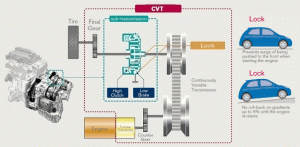
In order to eliminate the restraint of pressing down on the pedal when the engine is started, and to ensure the car does not roll back when restarting on a hill, a lock system is used on the CVT sub-transmission.
Through this system, it is possible to reduce the action of pressing down before restarting the engine. It also prevents against roll-back down a hill with the use of auxiliary braking (possible on hills with gradients up to 6%).
The Idling Stop utilizes a sensor to detect when the engine is being reversed in order to reduce the time for restarting. Ordinarily an engine takes four cycles to start but with the Idling Stop it only takes two cycles. As a result the engine restart time can be reduced to just 0.2 seconds.
Connect with us


Recent Blog Entries
- Passport Nissan VA’s Guide to Maintaining Your Nissan
- Mastering the Art of Remote Start: A Comprehensive Guide from Passport Nissan VA
- Mastering Voice Commands in Your Nissan – Unlocking the Power of Hands-Free Control
- Why Buy Nissan Certified Pre-Owned from Passport Nissan VA
- Routine Maintenance from Passport Nissan VA Keeps Your Vehicle Performing at Its Best